Pages

Tuesday, February 9, 2016

How Does Clay Help Kindergartners Learn The Skills They Need?

One friend decided she wanted to make a Chihuly inspired Macchia out of clay. She asked if she could paint it. I told her that particular clay did not dry, but I had some that did. She really wanted to make one so I got out some air dry clay. She carefully worked on it and then painted it beautifully after it dried. 


When the other kids saw this, they wanted to make one also. This shouldn't have surprised me since this group loves everything that has to do with creating works of art! I asked if they wanted to learn how to make things out of clay and explore clay further. They were very interested! They told me what they knew and wondered about clay, then I set up a table for them to explore trying to make some different things out of clay. I put some clay pots and a clay candle holder for some inspiration.

They learned how to use observational skills as they observed sculptures both real and pictures. They learned how to look closer and notice things like texture and shape. They learned how to wonder and ask questions like how did the pots become shiny and smooth? They learned to research to find answers. They asked experts like our art teacher or used technology to help them find answers. 


They worked their fine motor muscles to help them with writing as they worked the hard plasticine to make models. 


They learned writing skills. After exploring, we incorporated writing by making a plan and then practiced making a model out of plasticine. They were focusing on putting spaces between their words. 


They also had to learn persistence and how to deal with disappointment as I did not always accept their model.  After telling them what the problem was they had to try again! 

They learned how to follow a plan. They took their plan and model to the sculpture station. Here is where the air dry clay was for them to make their final sculpture. 


They learned first how to make a basic pinch pot by watching a video. Then we learned about how to score and slip to make two pieces stick together. Scoring is when you scratch the surface.  Slip is watered down clay to a consistency of slippery mud that you paint over the areas that you want to attach together. 


We sat them in the window to let them air dry. 


They learned how to focus and concentrate. After their sculptures dried, they painted them. Their focus and concentration amazed me! They were so purposeful and careful with every stroke! Many wanted to let them dry and then add more details with a tiny paint brush. Being able to focus and concentrate on something is so important in order for these kids to learn in future grades! 


They learned to use resources for accuracy. Our friend below wanted to use a resource so that the lava on her volcano sculpture was just right!


They learned about the attributes of 3D shapes. Because of their interest in clay I put some plasticine out for them to try to create 2D and 3D shape sculptures.


They learned how to explore and get their hands dirty! They had wondered what would happen if water was mixed with the clay. This turned into a wonderful sensory experience! They loved the feeling of clay squishing between their fingers! They also wondered what clay was. We found out from a video that it is basically mud!


They also learned that things take multiple steps to finish! Many thought they could just go to the air dry clay and make a sculpture. It took a lot of patience on their part as they realized this was not a one day process. It took one day to plan and make the model, another to create the sculpture, and another to paint it.  In an age of immediate gratification, this was a bit hard for some to accept, but in he end, they could see that the process was important to get the end product. 

They also learned how to handle disappointment as some sculptures broke, and persistence when they had to try again. 

They also learned how to be proud of their accomplishments. Making these sculptures were not easy. I love seeing how proud they are when ey know they did something hard and /or created something beautiful! Here are the final products of those who were interested in creating something out of clay. Most wanted to make a pinch pot, cup, or Chihuly inspired Macchia. A couple made candle or plant holders, one made a person and one made a volcano!


Yes, these kids need to learn how to read, write and do math. There are other skills though, at this age that are equally important (if not more) for them to learn. In order for them to learn academic skills as they get older, we want them to be persistent if they get to a hard word or math problem and not give up and move on. We want them to concentrate and focus on details of a story or a problem in math. We want them think creatively as they work out a new math concept. We want them to try again if they get a wrong answer. Most of all, I want them to use reading, writing, and math because they naturally have to. All of these skills were practiced and used. By having to use these skills in their inquiry, play, and projects, they just use them. They naturally want to learn how to read, write and use math skills because they see a need for them in everything we do. That is why we will spend a whole two weeks playing with clay in our classroom! 

Using 21st Century Skills To Create Our Own Math Games, a 3D Shape Challenge, and More

The kids really enjoyed the math challenges that I set out for them! Here are a few!  One challenge was to use the their creative thinking skills and the materials shown below to create a math game! They were very creative! As they played the games with each other, they were learning and practicing patience, taking turns, collaboration and problem solving. They used speaking and listening skills as they taught the class how to play their games. 


One friend came up with the idea below. You roll the dice and put that many beads on the ten frame. Your partner does the same. Whoever fills up both of their ten frames first wins. This game helps kids with subitizing (saying how many without counting), and using ten frames. Since there are two, the ten frames show that teens are a group of ten and some extra ones, and twenty is two groups of tens.


Below a friend came up with the idea of rolling the dice and putting that many beads in your side of the balance scale. Whoever has the heavier side at the end of the game wins. This works on subitizing and comparing weight. 


Here, each player picks a row. You take turns rolling the dice and move that many beads over. Whoever gets all of their beads to the other side first wins! This helps them learn subitizing, and shows different ways of making ten on he abicus.  


Here is a game where you collaborate. You each roll the dice and put that many hexagons on top of each other, creating a tower. If you make it fall, the other wins. 


Here a friend used connecting cubes to create a game board. You roll the dice and move that many spaces on the game board. Whoever gets to the end wins! There were so many more that I did not get pictures of. Some made game boards out of blocks or on paper also. All of these games also help with one to one correspondence when counting.


There has been a big interest in three dementional shapes. They need to be able to name them and describe the attributes of thhe shapes. I set up the invitation below for them to create both 2D and 3D shapes using marshmallows and toothpicks. They loved this! They also had to try their best to draw and label their shape. 


They glued a label onto their shape that had their name and the shapes name. 


Here are some of the literacy explorations I had set up as well.  This challenge is called Stack It. You build a castle with these sight word cups, but you can not use the cup unless you could read the sight word on it. 


Build sight words on the pipe cleaners and record them. 


Time how fast you can read the sight words. You can't put them in your pile unless you can read them. Count how many you could read in that amount of time. 


Pick a tile. If you can read the word, put it in one pile. If you can't, put it in another pile. See which pile is bigger. 


Be a detective and see if you can read the teeny tiny sight words with the magnifying glass. Record the words you can find. 


Pick a picture. How many syllables does it have? Put that many cubes on the picture. 


There are more but I did not get pictures. The kids work on math or literacy goals of their choosing while I work with small groups. They look in their data folders where all of their goals are, decide what they want to work on, then find the materials in the room to help them work on that goal. These are also always available during our Thinking, Learning, and Discovering Time for the kids to choose. 

Why Does Art Play Such An Important Part In Our Class

The kids in this class love art. Especially process art. This is when they just enjoy the process of creating art without directions or guidance from me. Why would I think this is beneficial and has a place in our classroom when there is so much pressure to stick to academics?

When children have opportunities to create in this way, they develope habits that will help them in every other area in the classroom such as Observing, Creating, Reflecting, Exploring, Engaging, Persisting, Colaborating, Developing Craft, Envisioning, and Expressing! These habits help students develop critical thinking skills that they will be able to apply in all the disciplines! These habits are just as important for math and science as they are for the arts. They are 21st Century Learning Skills that they will need to be successful in life. Employers want people who can collaborate together and use critical and creative thinking skills. Working on a collaborative art piece is one way to foster this! Many children love to express themselves through art so I make sure to provide plenty of experiences for them! Especially this class! 

On Black Friday I came across this wonderful 3X4 foot canvas for 70% off! I was thrilled because canvases are usually way too expensive for me to buy when they are this big! I set it up on the easel in our studio corner. 


I put out different shades of blue paint with some large brushes and told them they could do whatever they wanted on it. They started to paint pictures but then started getting into the process of mixing the colors all over the board. Before we knew it, they had covered he whole canvas and kept on going!


Each day they would choose a color and I would provide colors that would mix well with it.  Then I last them pick brushes and go at it!


At one point I layed the painting on the floor with some yarn and some paint and told them to use the yarn to put paint on the canvas. They loved this. They surprised me by sticking their wet, paint covered yarn to the canvas! I loved the texture it added! 


I love the finished product! I think it would look beautiful hanging in any house, museum or classroom!


We hung the finished product up in our dramatic play area. 


I love that the kids have added such beauty to our classroom environment!

Sunday, January 24, 2016

Inquiring About What Makes Something Sink or Float

One of our friends brought in some candy canes last December. He asked if he could put it in some water during Thinking, Learning and Discovery time. I showed him where the bowls were and he went to the water fountain and started exploring. When the kids saw what he did, they explored also!


They were fascinated that the candy cane "melted" and turned the water red! I found some science recording sheets for them to record what they noticed. 


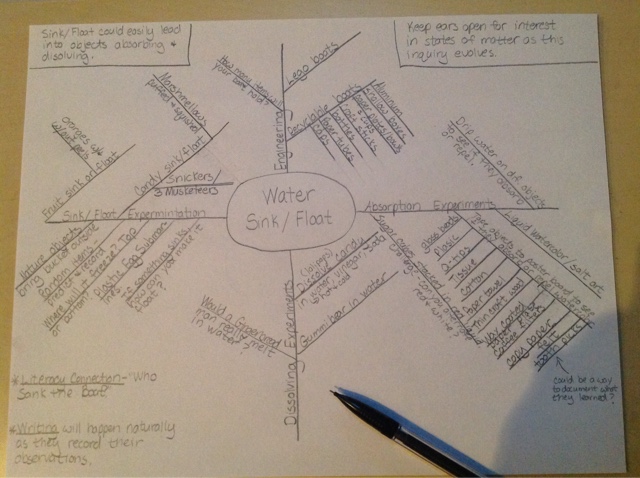
The kids then decided that they wanted to do water experiments. Most were very interested in exploring why some things sink and some things float so I set about planning some experiments to help them find answers. I wasn't sure if this would move in some other directions so I planned for some absorption and more dissolving experiences just in case. I often use a web map to organize my ideas. 


then set out experiences for them to explore and see what they could find out! Here I put out random objects for them to test and record what they noticed. 


I challenged them to create a boat with Legos and to see how many rocks it would hold.


I provided tin foil for them to design boats and test their strength by seeing how many glass beads it could hold. 


I set out some plasticine with the challenge of trying to make it float (None of us figured out how!).


They were very excited to get started!


Writing was incorporated through recording their observations and wonders. Below a friend noticed that "the puffy ball sank and floated." 


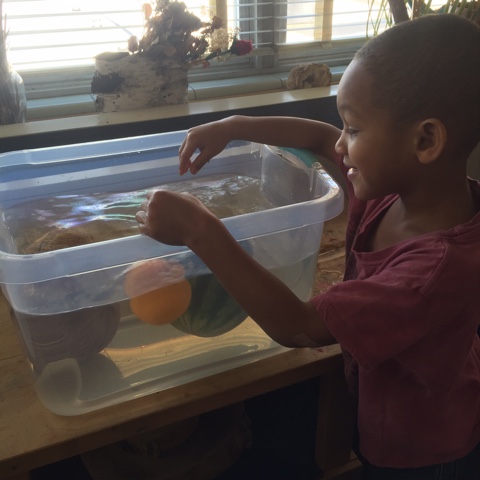
We also had an area with fruit and vegetables to see what would float.  They were so surprised that the heavy watermelon floated, yet the little grape sank! 


We also did some experiments as a whole class. Unfortunately I do not have many photos as I was out for meetings several days and a guest teacher did these with them.  We talked a lot about how scientists ask questions, make predictions and record what happened and what they learned from it. We talked about how our predictions can be wrong but that provides opportunities to problem solve and figure out why. We tested out a ping pong ball, golf ball and sphere shaped stone to see what would happen. 


They noticed the ping pong ball floated, the stone sank very hard and fast, but the golf ball floated down slowly. It was fun to listen to them try to figure out why! They knew the ping pong ball was lighter and had air inside of it. One friend guessed maybe the golf ball had a little air and the stone no air at all! The kids thought this made sense! 


We also experimented with a Snickers Bar and Three Musketeers Bar.  They looked the exact same on the outside so they were surprised one floated and one sank! When we cut them open they came to the conclusion that the 3 Musketeers bar had little holes with air and the nuts and caramel in the Snickers took up more space leaving less air!

We put an orange in and saw that it floated. We took the peel off of one and it sank! I asked why. They figured out right away that the peel helped hold in air. I showed them a lime. They thought it would float since it was like an orange. I put the lime in the water and it sank. They wanted me to cut it open to see why it sank when the orange floated. I did and passed it around. They noticed a big hole in the middle of the orange slices and figured out it held air while the lime did not have any holes or free space inside. 


The kids were definitely starting to see a connection between the amount of air and whether or not an object will sink or float! The vocabulary in their conversations were also starting to show this as they explored during Thinking, Learning and Discovery Time!  These kids have now had their first experiences experimenting and learning about density! 

One surprise from all of this was that all of a sudden, as we started these water explorations, rainbows started appearin in our room around 3:00 when we started our sharing circle! 


They could not figure out why until one day the rainbows didn't show up and a friend pointed out there was no sun shining in our room. The next day it was sunny so the kids started looking closer and noticed that all the rainbows came from the sun shining through our tanks of water that we had setting all over our room! 


It was fun to watch them as they worked together to figure it out! I love grabbing onto unplanned experiences like this and watching the thinking, learning and wondering that so naturally takes place! It is always worth stopping what was planned to grab onto the moment!

Saturday, January 9, 2016

A Day in a Reggio Inspired Kindergarten in a Public School System Setting: A Look at My Schedule

I have had many ask about what my schedule looks like, being a Reggio Inspired classroom. If you are inspired by the Reggio Emilia Philosophy, it can be very difficult to apply it in a public school setting here in the U.S.  Many ask how I do it, so here it is... It is not perfect, but it works for me.  My schedule is also attached at the end.

We always start out with breakfast. I love this because it gives the kids a chance to come in an socialize and share with each other. It also helps them become independent with many life skills that many cannot do when they first come like serving themselves, opening up food and drink cartons, and cleaning up after themselves.

 After breakfast, the kids clean up, scrub the tables and join in our meeting area for a morning message. I write this message in front of them and either model or think out loud writing strategies that I want them to focus on or I write it, then highlight sight words, blends, chunks, little words inside of big words, and any other reading strategies that will help them decode the message themselves. It only takes 5 minutes but packs some powerful reading and writing lessons!

On our longer days with no specials, we then have a lesson that has something to do with our inquiry. We may find out what they know and wonder about a subject they want to dig deeper in, read a book, watch a video, do an experiment and have meaningful discussions about we read, did, or had seen.

Most days we have two large blocks of Play-Based Learning Time which we call "Thinking, Learning and Discovering." This is when the kids are seeing, thinking and wondering about what is set out for them to explore. It is also where most 21st Century Skills such as team work/collaboration, problem solving, critical thinking, creative thinking and communicating skills are being used. They learn to be productive, take initiative, take leadership roles, and listen to others ideas and opinions. These need to be practiced in every grade! Not just Early Childhood! I set up experiences for them to explore and they make their thinking visible through plans, documentation, observational drawings, notes, data collection, and so much more. Some areas for them to explore are building, engineering, art, clay, science, creation station, library, dramatic play and math/literacy experiences. This is also the time when most of our small group inquiry investigations and projects happen.

We have whole group lessons to introduce new reading, writing and math skills that they need. These new skills are practiced and used during Thinking, Learning and Discovering time and materials are set out to specifically practice the reading, writing and math skills. We also have a specific time where they are specifically working on Literacy and Math stations to help them achieve their goals.

Our Literacy Lab is one of the most helpful resources that we have in our school. I feel so lucky to have this available to us! Our whole class goes into our Literacy Lab where the kids are divided into groups based on their needs. The kids who need intensive literacy intervention get it here. There are three teachers including me and four groups (In the past when we had Teaching Assistants we had 5 smaller groups). One teacher for intervention, one teacher for a guided reading group and then there are two groups that alternate between working with me in a guided reading group and an independent table with literacy experiences. With this set up, we meet with all the children in guided reading groups and literacy experiences within 30 minutes. That means I can focus my small groups in my room on those who need intervention and enrichment.

Of coarse, we go outside anytime the weather permits. The 21st Century Skills I mentioned above are used and practiced when the kids play outside. When outside play is taken away, their chances to problem solve, collaborate, take risks, be creative, socialize, take leadership roles, observe and discover are also taken away. It saddens me how little kids can practice these important life skills because so much of their play has been taken away from them in their schools when in actuality, the skills they need most in life are practiced as they play.

Our reflection time is another one of their favorite times of the day. Here we pass a "Sharing Stone" around our circle of friends and share something we did, made, discovered, or even something that happened to them that day. They are only allowed to talk if they hold the Sharing Stone. If kids have questions about what a student shared, they may raise their hand and that student will call on them. The kids are so respectful and quiet during this time. This time is very special to them and they take it very seriously!

Calendar is how we end our day. This is a traditional calendar where we quickly do the date, count the days of school and study the 100 chart, and sing songs about math concepts we are learning. We also talk about the daily and seasonal weather as we graph the weather each month.

Hopefully this post will help answer the many questions I get about what my typical day looks like in a Reggio inspired classroom in a public school system. Just remember  the beautiful thing is that you can make a schedule that works for you.  If you don't have time for two blocks of play-based learning because of curriculums mandated by your school or you are mandated to spend a lot of time pulling out guided reading groups, try to squeeze one in instead!  I had to take some risks to make room for those times and they have paid off!  For example, Independent Writing time did not need to be as long since they were using writing skills during other parts of the day, so I cut it in half.

So that is my day! I do have to say that we do not always stick to our schedule!  Often learning opportunities pop up that we have to grab onto!  That is part of having an emergent curriculum!  This does provide a base for how our day might look.  I have provided my schedule below for you so that you can see the whole schedule at a glance.