Project/Inquiry Based Learning has been a passion of mine ever since I discovered it about 5 years ago. Since then, I have stepped out of my comfort zone and transformed the way I teach from a typical Thematic Based style through baby steps taken each year and with the help of an amazing on-line community of teachers with the same passion (you all know who you are!). My first baby step was taking themes and science/social studies standards and making them more student lead and project based. I got rid of the two week time limit each theme had in the past and allowed more time for students to dig deeper. I found that students would take my broad theme (oceans) and desire to dig deeper into more specific parts of the theme (sharks, jellyfish, ect.). As time went on, I was able to take the biggest step and totally let go of my themes and allowed the children's interests drive my instruction, incorporating the standards through those interests.
I am blessed enough to also teach in a district that does not mandate the curriculum I use. Curriculum programs are purchased to use as tools for our toolbox but not required. Us teachers are trusted and encouraged by our superintendent to write our own curriculum as long as the standards are met. My building principle also has that kind of faith in us as professionals! They know that when it comes to children learning what they need to learn, we are the experts! Project/Inquiry Based Learning is highly encouraged in all grades Pre-K through 12.
Some wonder how I plan for this style of teaching and how it flows. Here are some of the tools that I use.
Once I notice an interest from the students (usually found out through experiences set up for them to explore during play) , I find out what their knowledge and misconceptions are about the subject. Kind of like a KWL chart! I list all that they know about the subject we will dive into. Then I ask what they wonder. I list all of their questions. NOW I can plan!
I take their wonderings and create a web map showing the different directions they want to take the inquiry and possible experiences that will help them find answers to their wonderings. I got this web map from the amazing Joanne Babalis and her amazing blog
http://myclassroomtransformation.blogspot.com. On the back I have all of the Literacy and Math Standards listed so that I can highlight the ones we will focus on through the inquiry and project. I add any Science and Social Studies Standards to the bottom of the web map. Here is the link to the web map if you would like it:
Web Organizer
Once I organize my thoughts, I create my inquiry plan using a template I created based on one I found from a Texas school district. It was so long ago I have no memory of which district but if I find out I will add them to give them credit. Their form was 3 pages long. I tweaked it to fit it all on one page. I use this to show the objectives and vocabulary, plan the investigations and materials I will need, show how they will organize the data about what they have learned, possible projects that could result from the inquiry and how we will present the project to the community.
The next step is to start the investigation phase. In early childhood I set out experiences for them to explore and document what they notice. We also do whole group and small group investigations through books, videos and hands-on experiences. As we answer questions, we add the answers to our wonder chart to show our new learning. We organize this data in a web map format for all to see.
 |
| The start of an inquiry wall. Information is added to it as we learn. |
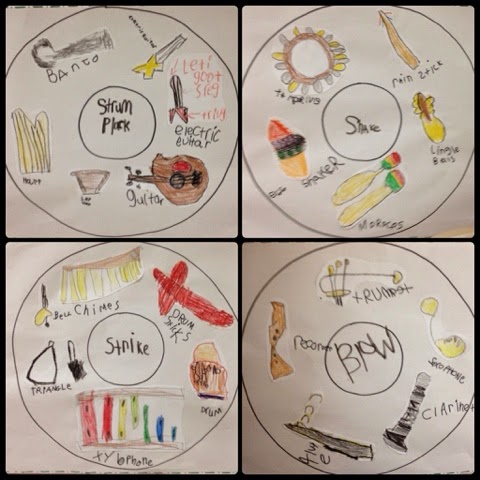
Once we have investigated we use organizational maps to show what we learn. In kindergarten it usually consists of web maps, circle maps, tree charts (can/have/are maps), and brace maps (to show part to whole). We will chose one or two to organize our data.
The next step is the project. We take what we learn and create something to show it! The projects can be individual, small group, or whole group.
Some examples of projects in our room have been turning an area of our room into an ocean, forest and sky to show how animals adapt in the winter. The kids signed up to be on the migration team, adaption team or hibernation team. They each became experts on their part during the investigation and worked on their part of the project.
 |
| An area for everyone in our school to explore sound which is in our science standards. |
They have also turned the inside of our room into a great hall and medeival kitchen and the outside of our room into a castle wall complete with moat and drawbridge after investigating castles!
 |
| A mural planned and created by Kindergartners. |
The last step is the presentation to show what they had learned. The kids LOVE this part and I've never had a child refuse to present! They are so confident of what they have learned and proud of what they have done that they cannot wait to share it! I am always so impress with their speaking and listening skills during these presentations! Sometimes small groups go to other classrooms and present what they learned, sometimes we invite parents or other classes to our room to see our presentation, and sometimes we create a video to share with others. They create maps, big books, and, get to show off the projects created at this time! Showing what they have learned through these projects gives the projects an even bigger sense of purpose! They can't wait to show others what they have learned and done!
 |
| Presenting different weapons used during medieval times. |
I have never had so much fun teaching in my 22 years as I have he past four years! I could never go back to the way I had done it I the past. The benefits of this way of teaching are not only meeting the standards (the old way did that too) but the 21st Century Skills they are forced to develope when they learn in this type of environment. When inquiring, investigating and creating within thier own interest, they are motivated to collaborate, problem solve, handle frustration, persist if things don't work the first time, and learn from their mistakes. They have to use critical thinking skills and develope research skills. When kids develop these skills, they can learn ANYTHING!
My new passion that I am learning to incorporate in my classroom is Playbased Learning! I have been amazed by the learning taking place in this way also....but that's another post!
SaveSave